
Infant Language Milestones
Infant Language Milestones
As soon as babies are born, they begin their language development journey. This journey will take years to perfect, and might not always be noticeable, but is constantly working behind the scenes to take them from stage to stage. Today, I want to talk about those development milestones that infants will reach from birth to 18 months, because the science behind it is absolutely fascinating. Infants are doing way more than we can see on the surface!
Infants achieve key language development milestones in their first year, progressing through stages such as speech perception, understanding actions and intentions, forming categories, and producing early vocalizations. Language development is incremental, with abilities building gradually rather than appearing all at once.
According to the Stark Assessment of Early Vocal Development—Revised (SAEVD-R), there are 5 language development stages that infants will progress through:
Infants achieve key language development milestones in their first year, progressing through stages such as speech perception, understanding actions and intentions, forming categories, and producing early vocalizations. Language development is incremental, with abilities building gradually rather than appearing all at once.
According to the Stark Assessment of Early Vocal Development—Revised (SAEVD-R), there are 5 language development stages that infants will progress through:
- Reflexive Stage (0-2 Months)
- Control of Phonation Stage (1-4 Months)
- Expansion Stage (3-8 Months)
- Basic Canonical Syllables Stage (5–10 months)
- Advanced Forms Stage (9–18 months)
Stage 1- Reflexive (0-2 Months)
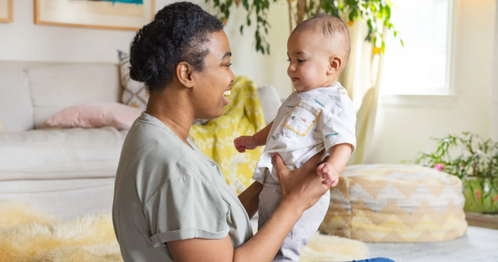
Infants produce involuntary sounds like crying, fussing, burping, coughing, and sneezing in this stage. Adults often interpret these as communicative, responding to them as if they have meaning. In fact, communicating with infants even has its own term known as Infant Directed Speech (IDS)! IDS is observed universally across many languages and even in speech to infants with cochlear implants, suggesting its important role in supporting early language acquisition.
Ever notice that when you're speaking to an infant, your voice gets higher? You might slow down your talking speed, exaggerate words, and shorten your sentences or questions. For example, adults might say “See bike?” instead of “Do you see that bike on the sidewalk?” All of these are adults' natural instinct to switch their language from Adult Directed Speech to Infant Directed Speech. Using IDS is one of the most important things you can do to help your child at this stage. Talk to them as you change their diaper, as you feed them, during bath time, etc. The more you talk to them, the easier it will be for them to develop their early language skills.
Here is a quick list of concepts your infant will develop in the first 2 months:
Ever notice that when you're speaking to an infant, your voice gets higher? You might slow down your talking speed, exaggerate words, and shorten your sentences or questions. For example, adults might say “See bike?” instead of “Do you see that bike on the sidewalk?” All of these are adults' natural instinct to switch their language from Adult Directed Speech to Infant Directed Speech. Using IDS is one of the most important things you can do to help your child at this stage. Talk to them as you change their diaper, as you feed them, during bath time, etc. The more you talk to them, the easier it will be for them to develop their early language skills.
Here is a quick list of concepts your infant will develop in the first 2 months:
- Response to Sound:
Reacts to loud sounds and may start or stop sucking in response to sound during feeding. - Response to Voice:
Calms down or smiles when spoken to and recognizes a familiar caregiver’s voice, often calming if crying. - Early Social Communication:
Smiles when seeing a caregiver, showing emerging social engagement. - Early Vocalizations:
Coos and makes pleasure sounds, indicating early, non-meaningful speech-like sounds. - Crying Patterns:
Has a special way of crying for different needs, signaling early differentiation in communication.
Stage 2- Control of Phonation (1-4 Months)
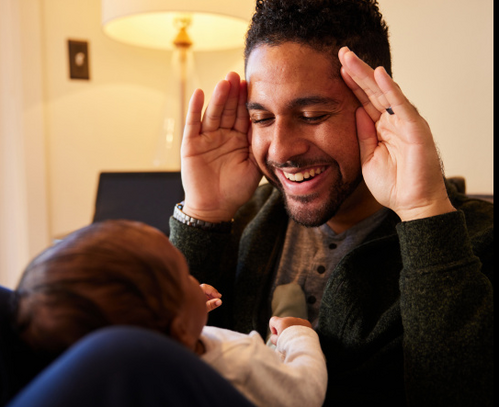
Milestones infants reach from 1–4 months focus mainly on early hearing, attention to sound, and first vocal behaviors that support later language. These months are about noticing sounds, responding to voices, and beginning to “talk” with coos and cries. During this stage, caregiver responsiveness and daily routines influence language development the most.
Daily routines such as feeding, bathing, dressing, and diaper changing provide infants with comfort, predictability, and repeated opportunities for language exposure. Routines also facilitate episodes of joint attention, where infants and caregivers focus on the same activity, further supporting language development.
Caregiver responsiveness refers to how attentively and sensitively caregivers respond to infants’ vocalizations and communicative attempts, reinforcing that their behaviors are valued. Both the quality and quantity of caregiver responsiveness significantly influence early language development, often more than infants’ own early communicative behaviors. Research shows a positive association between caregiver responsiveness and improved language development in children, including those with expressive vocabulary delays.
Seven key indicators of caregiver responsiveness are:
Daily routines such as feeding, bathing, dressing, and diaper changing provide infants with comfort, predictability, and repeated opportunities for language exposure. Routines also facilitate episodes of joint attention, where infants and caregivers focus on the same activity, further supporting language development.
Caregiver responsiveness refers to how attentively and sensitively caregivers respond to infants’ vocalizations and communicative attempts, reinforcing that their behaviors are valued. Both the quality and quantity of caregiver responsiveness significantly influence early language development, often more than infants’ own early communicative behaviors. Research shows a positive association between caregiver responsiveness and improved language development in children, including those with expressive vocabulary delays.
Seven key indicators of caregiver responsiveness are:
- Waiting and listening: Caregivers wait expectantly for the child’s initiations, use a slow pace, and listen to allow message completion.
- Following the child’s lead: Caregivers respond verbally and animatedly to the child’s initiations.
- Joining in and playing: Caregivers participate in the child’s focus of interest and play without dominating.
- Being face-to-face: Caregivers adjust their physical position to facilitate direct interaction.
- Using a variety of questions and labels: Caregivers ask diverse wh- questions, use yes–no questions for clarification, and wait for responses.
- Encouraging turn taking: Caregivers balance conversational turns.
- Expanding and extending: Caregivers repeat and expand on children’s words using correct grammar.

Stage 3- Expansion (3-8 Months)
Several communication and language milestones are highlighted for infants around 3–8 months.
During this stage, one of the best things you can do at home is to encourage their babbling. Show them that their communication attempts exhibit a response from you.
Talk through daily routines
During feeding, dressing, bathing, and diaper changes, narrate what you’re doing: repeating simple phrases and comments (like “Open wide,” “All done,” “Here’s your shirt”) gives your baby lots of consistent sound patterns to listen to and learn from. These routines happen every day, so they provide frequent, predictable chances to hear language.
Engage and respond
Spend time face-to-face, watching and responding to your baby’s coos, gurgles, and early consonant–vowel combinations (“ba,” “goo,” “tata”). Babies often babble when excited or when they want attention, and they may babble in longer strings to get and keep your attention. Reacting—smiling, imitating their sounds, and talking back—encourages them to keep experimenting with sounds and building toward more complex babbling.
Playful interaction
Simple games like peek-a-boo and patty cake also support vocal play and babbling as your baby anticipates and enjoys the sound patterns in the game.
- Infants gain more control over their articulators (tongue, lips, jaw).
- They produce clear, isolated vowel sounds.
- They experiment with loudness and pitch, often squealing or producing series of squeals.
- They begin marginal babbling—early babbling with consonant-like and vowel-like sounds.
- Follow sounds with their eyes and notice toys that make sound.
- Respond to changes in your voice tone and pay attention to music.
- Babble in a speech-like way using many sounds, including those starting with p, b, and m.
- Laugh, babble when excited or unhappy, and make gurgling sounds during play.
During this stage, one of the best things you can do at home is to encourage their babbling. Show them that their communication attempts exhibit a response from you.
Talk through daily routines
During feeding, dressing, bathing, and diaper changes, narrate what you’re doing: repeating simple phrases and comments (like “Open wide,” “All done,” “Here’s your shirt”) gives your baby lots of consistent sound patterns to listen to and learn from. These routines happen every day, so they provide frequent, predictable chances to hear language.
Engage and respond
Spend time face-to-face, watching and responding to your baby’s coos, gurgles, and early consonant–vowel combinations (“ba,” “goo,” “tata”). Babies often babble when excited or when they want attention, and they may babble in longer strings to get and keep your attention. Reacting—smiling, imitating their sounds, and talking back—encourages them to keep experimenting with sounds and building toward more complex babbling.
Playful interaction
Simple games like peek-a-boo and patty cake also support vocal play and babbling as your baby anticipates and enjoys the sound patterns in the game.
Click the video below to see Ms Rachel demonstrate how to play patty cake with your infant (starts around 16 seconds):
Stage 4- Basic Canonical Syllables (5-10 Months)
Language milestones in this stage are mainly about sound play and early babbling. Babies gain control over their mouth and voice, producing clearer consonant–vowel syllables that start to resemble real speech. They also begin to use babbling socially, to get and keep your attention, and may start using gestures.
By around 8 months, infants start to communicate intentionally using preverbal language functions, even before they can speak actual words.
Key preverbal functions include:
Encouraging at home:
By around 8 months, infants start to communicate intentionally using preverbal language functions, even before they can speak actual words.
Key preverbal functions include:
- Attention seeking to self (e.g., tugging on clothing to get attention)
- Attention seeking to events, objects, or people (e.g., pointing to draw attention)
- Requesting objects (e.g., pointing to indicate desire for an object)
- Requesting action (e.g., handing objects to adults to prompt an action)
- Requesting information (e.g., pointing to objects to get labels or information)
- Greeting (e.g., waving “hi” or “bye-bye”)
- Transferring (e.g., giving a toy to another person)
- Protesting or rejecting (e.g., crying or pushing objects away)
- Responding or acknowledging (e.g., smiling or laughing in response to others)
- Informing (e.g., pointing to a broken part of a toy to indicate something is wrong)
Encouraging at home:
- Engage face-to-face, respond to babbles, and wait for “turns.”
- Expand what your baby says (e.g., “ba” → “Yes, ball!”) and use rich labels and questions to keep interaction going.

Stage 5- Advanced Forms (9-18 Months)
Milestones infants develop during 9–18 months involve rapid growth in understanding and using language, building on achievements from the first year. During this period, infants move from simple babbling and a few words to following directions, naming objects, and combining words. These milestones reflect advances in speech perception, vocabulary, and early sentence building.
Receptive language (comprehension) develops faster than expressive language (production) in infants. For example, 1-year-olds typically understand about 80 words but can only say around 10, and likely only express 1 word by their first birthday. This shows that there is much more going on behind the scenes than what we can actually see or hear from infants. Language production is more demanding than comprehension, requiring infants to use more abilities, which leads to earlier milestones in understanding language than in speaking it.
Lastly, it is important to note that language development varies widely among infants, with differences in the rate of development, communicative purposes, and placement on the continuum from late to early talkers.
Receptive language (comprehension) develops faster than expressive language (production) in infants. For example, 1-year-olds typically understand about 80 words but can only say around 10, and likely only express 1 word by their first birthday. This shows that there is much more going on behind the scenes than what we can actually see or hear from infants. Language production is more demanding than comprehension, requiring infants to use more abilities, which leads to earlier milestones in understanding language than in speaking it.
Lastly, it is important to note that language development varies widely among infants, with differences in the rate of development, communicative purposes, and placement on the continuum from late to early talkers.
- Statistical measures like mean and median are used to describe milestones, but these are averages and do not represent individual infants; there is significant variation in when milestones are achieved.
- Receptive and expressive vocabularies differ greatly among infants; at 12 months, infants may understand 15–150 words and produce 0–30 words, while at 16 months, understanding ranges from 80–300 words and production from 0–150 words.
- Age explains only a small portion of vocabulary variance, with other factors such as socioeconomic status (SES) and parental talk accounting for the majority.
In Conclusion
Infants will achieve great milestones throughout their first 18 months. They go from uncontrolled sounds like crying and sneezing, all the way to their first words. There are so many processes that their brain goes through to achieve these goals, and no baby is exactly like another. Give your baby the time and energy to devote to their language development, and don't be concerned if your baby can only say 1 word, but their cousin can say 3. Late talkers are defined as children producing fewer than 50 words by age 2. Early talkers are those producing an average of 475 words at 21 months compared to the typical 200.
It is generally difficult to assess language delays before toddlerhood, but clinicians may evaluate infants with developmental disabilities or those lagging in milestones. Informal language screens use checklists of early language milestones to help clinicians and parents track whether infants exhibit specific behaviors. These milestones are grouped by age:
It is generally difficult to assess language delays before toddlerhood, but clinicians may evaluate infants with developmental disabilities or those lagging in milestones. Informal language screens use checklists of early language milestones to help clinicians and parents track whether infants exhibit specific behaviors. These milestones are grouped by age:
- Birth to 3 months: Reacts to loud sounds, calms when spoken to, recognizes voices, coos, and has distinct cries for different needs.
- 4 to 6 months: Follows sounds with eyes, responds to tone changes, notices sound-making toys, babbles with varied sounds (like p, b, m), laughs, and makes gurgling sounds.
- 7 months to 1 year: Enjoys interactive games, turns toward sounds, understands common words, responds to requests, babbles in long/short groups, uses gestures, and may have one or two words by first birthday.
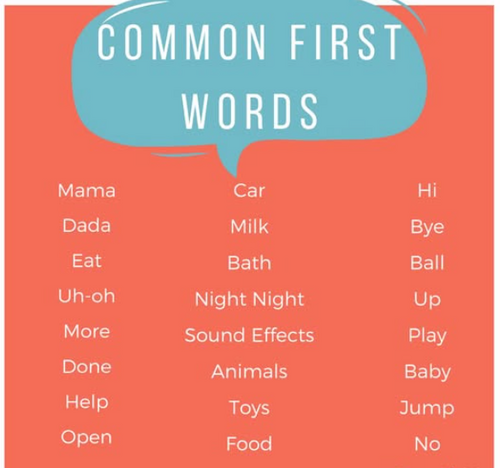
Above is a list of common first words you could expect your child to say. Other first words could be anything that is frequently repeated to them, or something that they absolutely love! Maybe when you get them dressed in the morning, you always say "Right sock, left sock" and because of the frequency, your baby's first word might be "sock"!
Rest assured, as Risen Savior is constantly monitoring your child's language development milestones and will work with you to establish/quell any concerns you may have. Please do not hesitate to reach out to our staff for any questions regarding language development milestones for your child!
Makenna
Rest assured, as Risen Savior is constantly monitoring your child's language development milestones and will work with you to establish/quell any concerns you may have. Please do not hesitate to reach out to our staff for any questions regarding language development milestones for your child!
Makenna
Recent
Archive
2026
Categories
no categories
No Comments