
Why Play Builds Strong Readers
Why Play Builds Strong Readers
"Play is the work of children. Our job is to complicate the play."
Here at Risen Savior Early Childhood Center, we pride ourselves on play based learning. We believe learning should be fun and meaningful. Our classes are designed to meet the interests of the children. They have the opportunity to explore, discover and create their own knowledge through developmentally appropriate activities. As a 4-star center, we set high standards of quality care and education.
But the big question on parents' minds is- how does play contribute to reading? How does play prepare our children for the academic challenges of elementary school and beyond?
First, let's talk about Vygotsky's Zone of Proximal Development (ZPD). ZPD isn't just a fun reference to the Zootopia Police Department! It is the metaphorical space between what a learner can do independently and what they can achieve with guidance. Introduced by psychologist Lev Vygotsky, it represents the optimal learning phase where a task is challenging but entirely doable with the right support.
But the big question on parents' minds is- how does play contribute to reading? How does play prepare our children for the academic challenges of elementary school and beyond?
First, let's talk about Vygotsky's Zone of Proximal Development (ZPD). ZPD isn't just a fun reference to the Zootopia Police Department! It is the metaphorical space between what a learner can do independently and what they can achieve with guidance. Introduced by psychologist Lev Vygotsky, it represents the optimal learning phase where a task is challenging but entirely doable with the right support.
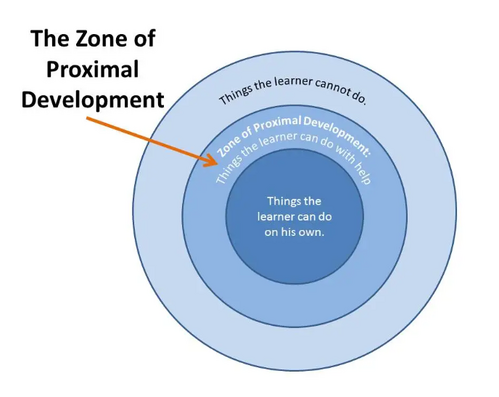
In the above image, we can see that the center circle encompasses things a learner can do on their own. This would be considered things that are simple, and easy for a child. If their learning environment only accommodates this inner circle, they are not challenged, will not grow, and will become bored, leading to more behavior issues.
The outer ring is what a learner cannot do. This would be like giving a 4 year old double digit addition with regrouping and asking them to complete it with no help. As expected, this is when they become over challenged. They give up, they hate learning, and again, we see an increase in behavior problems.
The middle ring is the sweet spot. This is the Zone of Proximal Development! These are activities that the learner cannot complete alone, but they can succeed at with guidance. That guidance gives them the confidence to eventually be able to do the task on their own. The learner is just the right amount of challenged to keep them excited, motivated, and ready to learn.
Based on this research, we can provide children with play based strategies that perfectly fit within their ZPD.
Here is an example:
A 2 year old classroom is learning about frogs. First, they read "That's Not My Frog..." by Usborne which uses bright colors and different textured patches for little hands to explore. We know that children who are 2 years old are just starting to develop phonological awareness (the ability to interpret the sound they hear in spoken language). With this knowledge, the teacher creates a play-based activity, within the students' ZPD, to reinforce their beginning phonological knowledge.
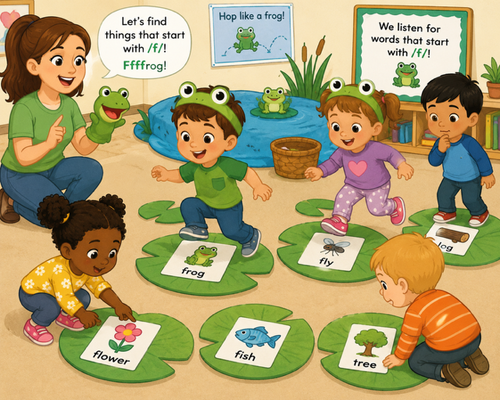
The teacher creates an activity called Froggy Sound Hop. Students hop from lily pad to lily pad, and discover pictures of frogs and other familiar objects while listening for words that begin with the /f/ sound, such as frog, fly, flower, and fish. Together, they exaggerate the beginning sound in each word, repeat it aloud, and celebrate our discoveries through movement, songs, and pretend play. They will also come across words that do not start with that /f/ sound, such as tree or log, to help them recognize the difference between /f/ and other sounds.
At 2 years old, children are just beginning to notice that words are made up of different sounds. They are not expected to identify these sounds on their own yet, but with guidance from caring adults, they can begin to hear similarities between words and enjoy experimenting with language. This type of playful support helps children build confidence while strengthening important listening and communication skills.
Activities like Froggy Sound Hop also encourage gross motor development, imaginative play, vocabulary growth, and social interaction—all while laying the foundation for future reading success. By combining movement, exploration, and joyful learning, we help children discover that learning can be both meaningful and fun.
The outer ring is what a learner cannot do. This would be like giving a 4 year old double digit addition with regrouping and asking them to complete it with no help. As expected, this is when they become over challenged. They give up, they hate learning, and again, we see an increase in behavior problems.
The middle ring is the sweet spot. This is the Zone of Proximal Development! These are activities that the learner cannot complete alone, but they can succeed at with guidance. That guidance gives them the confidence to eventually be able to do the task on their own. The learner is just the right amount of challenged to keep them excited, motivated, and ready to learn.
Based on this research, we can provide children with play based strategies that perfectly fit within their ZPD.
- We don't put 2-year-old activities in a 4-year-old room.
- We rotate activities to maintain interest.
- We play with the children to introduce new concepts and ideas.
- We use play to reinforce the new concepts and ideas.
Here is an example:
A 2 year old classroom is learning about frogs. First, they read "That's Not My Frog..." by Usborne which uses bright colors and different textured patches for little hands to explore. We know that children who are 2 years old are just starting to develop phonological awareness (the ability to interpret the sound they hear in spoken language). With this knowledge, the teacher creates a play-based activity, within the students' ZPD, to reinforce their beginning phonological knowledge.
The teacher creates an activity called Froggy Sound Hop. Students hop from lily pad to lily pad, and discover pictures of frogs and other familiar objects while listening for words that begin with the /f/ sound, such as frog, fly, flower, and fish. Together, they exaggerate the beginning sound in each word, repeat it aloud, and celebrate our discoveries through movement, songs, and pretend play. They will also come across words that do not start with that /f/ sound, such as tree or log, to help them recognize the difference between /f/ and other sounds.
At 2 years old, children are just beginning to notice that words are made up of different sounds. They are not expected to identify these sounds on their own yet, but with guidance from caring adults, they can begin to hear similarities between words and enjoy experimenting with language. This type of playful support helps children build confidence while strengthening important listening and communication skills.
Activities like Froggy Sound Hop also encourage gross motor development, imaginative play, vocabulary growth, and social interaction—all while laying the foundation for future reading success. By combining movement, exploration, and joyful learning, we help children discover that learning can be both meaningful and fun.
There are many other ways that play builds strong readers, but we'll just talk about one more for now!
All things start at 0. Babies are not born understanding how to speak, read, or even play. All things need to be taught; and we can't teach things in any order that we want. There are neurological development pathways in our brains that follow a specific pattern of what needs to happen before something else.
Take a look at these stairs:
All things start at 0. Babies are not born understanding how to speak, read, or even play. All things need to be taught; and we can't teach things in any order that we want. There are neurological development pathways in our brains that follow a specific pattern of what needs to happen before something else.
Take a look at these stairs:
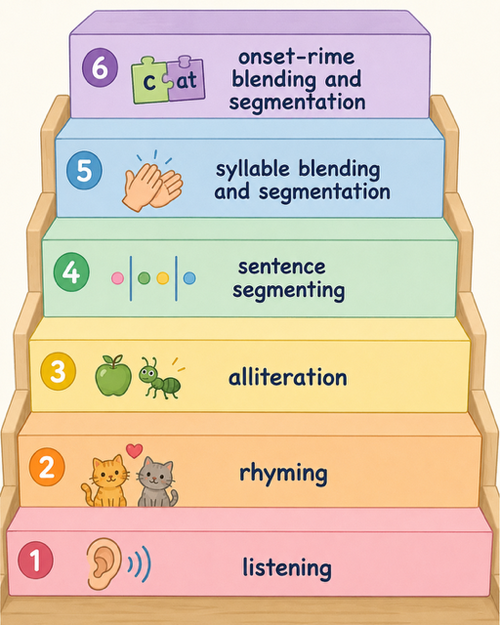
The stairs represent the developmental steps that take place in a child's mind to make them a successful speaker and reader.
Babies and infants start learning language by listening. They listen to you all day long, creating new pathways in their brain to eventually be able to express what they've listened to into formed words. Next they can move on to rhyming, alliteration, and eventually reach the top step.
Let's say a child is working on developmental step #2- rhyming.
Sure, you can give a child a worksheet that asks them to match rhymes; but imagine building rhymes instead. Let's put pictures and words onto blocks and ask children to build the tallest rhyme tower with you. Doesn't that sound way more fun than a worksheet? Now we're building our imaginations, we're physically moving our bodies, practicing balancing blocks, and rhyming all at the same time.
At first glance, rhyming games may seem like simple fun, but they play an important role in preparing young children to become successful readers. Remember when I talked about phonological awareness in the frog activity? Rhyming is one of the earliest and most enjoyable ways to build it. It helps them to recognize patterns in language and teaches them that words are made up of seperate sound parts (morphemes and phonemes). This later develops into the ability to sound out unfamiliar words, recognize word families, and decode text as they learn to read.
In Conclusion
All of us here at Risen Savior ECC believe in brain science, and brain science tells us that children learn in specific steps, at specific levels. We are here to meet children at those levels and provide developmentally appropriate activities to support their learning milestones. We don't over challenge them by giving a 2-year-old a 4-year-old activity. We don't oversimplify by giving a 4-year-old a 2-year-old activity. Most importantly, we make learning relevant and exciting; and we do all of this through play.
If you are interested in learning more about brain science, and how play based curriculum supports it, feel free to reach out!
Thank you for stopping by for another blog post, stay tuned for more soon!
Makenna
Babies and infants start learning language by listening. They listen to you all day long, creating new pathways in their brain to eventually be able to express what they've listened to into formed words. Next they can move on to rhyming, alliteration, and eventually reach the top step.
Let's say a child is working on developmental step #2- rhyming.
Sure, you can give a child a worksheet that asks them to match rhymes; but imagine building rhymes instead. Let's put pictures and words onto blocks and ask children to build the tallest rhyme tower with you. Doesn't that sound way more fun than a worksheet? Now we're building our imaginations, we're physically moving our bodies, practicing balancing blocks, and rhyming all at the same time.
At first glance, rhyming games may seem like simple fun, but they play an important role in preparing young children to become successful readers. Remember when I talked about phonological awareness in the frog activity? Rhyming is one of the earliest and most enjoyable ways to build it. It helps them to recognize patterns in language and teaches them that words are made up of seperate sound parts (morphemes and phonemes). This later develops into the ability to sound out unfamiliar words, recognize word families, and decode text as they learn to read.
In Conclusion
All of us here at Risen Savior ECC believe in brain science, and brain science tells us that children learn in specific steps, at specific levels. We are here to meet children at those levels and provide developmentally appropriate activities to support their learning milestones. We don't over challenge them by giving a 2-year-old a 4-year-old activity. We don't oversimplify by giving a 4-year-old a 2-year-old activity. Most importantly, we make learning relevant and exciting; and we do all of this through play.
If you are interested in learning more about brain science, and how play based curriculum supports it, feel free to reach out!
Thank you for stopping by for another blog post, stay tuned for more soon!
Makenna
Recent
Archive
2026
Categories
no categories
No Comments